

From Battlefields to Cartels: How AI and Autonomous Technologies Are Changing Organized Crime
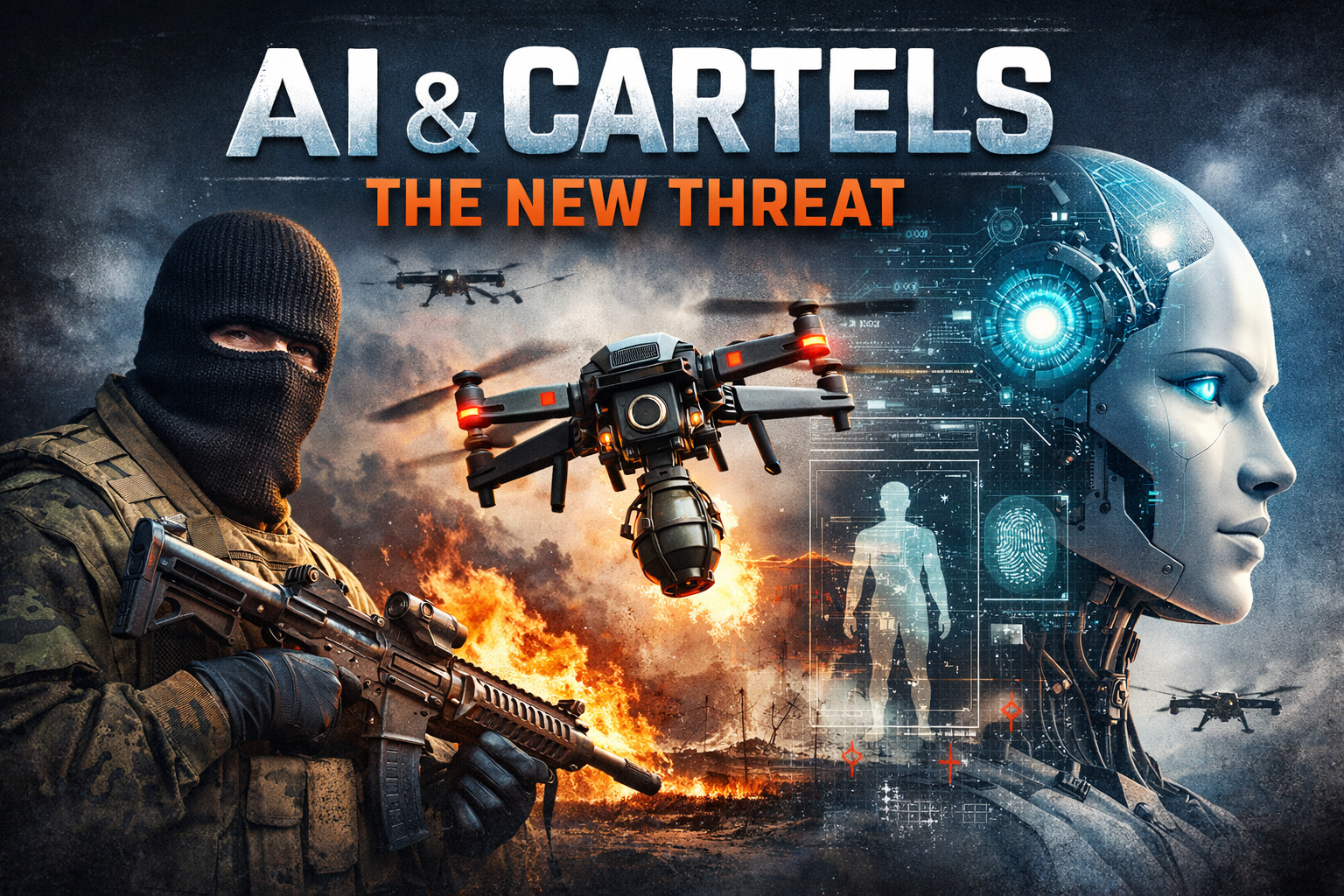
By Tessa Nejla Ayvazoglu — VirtexAI
Artificial intelligence is rapidly reshaping the global technological landscape. Governments, defense agencies, and major technology companies are investing heavily in AI-powered systems capable of autonomous decision-making, battlefield analysis, and advanced robotics.
Much of the public conversation about AI and security focuses on geopolitical competition between major powers.
However, there is another dimension that receives far less attention:
the diffusion of advanced technologies into the hands of non-state actors.
Among these actors, organized criminal networks—particularly powerful drug cartels—may represent one of the most underestimated risks in the emerging AI era.
The Rise of Autonomous Technologies in Warfare
Modern conflicts increasingly rely on artificial intelligence and autonomous systems.
In recent years, drone technology has transformed the way militaries conduct surveillance, reconnaissance, and targeted strikes. Autonomous navigation, sensor fusion, and computer vision allow relatively low-cost systems to perform tasks that once required sophisticated military platforms.
Examples from recent conflicts illustrate this trend.
In the war in Ukraine, both sides have deployed AI-assisted drone systems for reconnaissance and targeting. Loitering munitions such as the Shahed-136 drone demonstrate how autonomous navigation and pre-programmed targeting can enable effective long-range attacks without continuous human control.
Meanwhile, military research programs such as DARPA’s OFFSET (Offensive Swarm-Enabled Tactics) and the Pentagon’s Perdix micro-drone swarm project have explored decentralized drone swarms capable of coordinating actions with minimal human intervention.
These developments point toward the emergence of agentic AI systems—AI architectures capable of planning, adapting, and executing tasks autonomously.
Agentic systems can close the OODA loop (Observe-Orient-Decide-Act), analyzing data, making decisions, and executing actions with limited human input.
For governments and military strategists, this represents a powerful technological advantage.
But technological innovation rarely stays confined to the environments where it was first developed.
Technology Diffusion: A Historical Pattern
History shows that many technologies originally developed for military purposes eventually spread into civilian and commercial use.
Examples include:
• GPS
• the internet
• satellite communications
• drones
Over time, these technologies moved from military laboratories into commercial markets. As costs declined and accessibility increased, they became widely available across industries.
Drone technology is a particularly clear example of this diffusion.
Originally developed for military reconnaissance and surveillance, drones are now used in photography, agriculture, logistics, infrastructure inspection, and disaster response.
However, the same accessibility that enables innovation also introduces new risks.
As technology becomes cheaper and more widely available, it becomes easier for non-state actors to acquire and adapt it.
The Drone Revolution in Organized Crime
Over the past decade, organized criminal groups—especially in Latin America—have increasingly adopted drone technology.
In Mexico, the Jalisco New Generation Cartel (CJNG) has reportedly used drones for surveillance and tactical reconnaissance during conflicts with rival groups and government forces.
Investigations reported by Reuters and BBC News have documented cases in which commercial drones were modified to carry and drop explosive devices during cartel confrontations.
These drones typically originate from commercial platforms designed for civilian purposes.
With relatively simple modifications, however, they can be repurposed for tactical operations.
While these systems are still relatively basic compared to military drones, they represent a significant shift in the operational capabilities of organized crime.
Cartels are no longer limited to firearms and ground-based tactics.
Some groups are beginning to experiment with technologies that resemble lightweight aerial capabilities.
How Criminal Networks Acquire Emerging Technologies
Contrary to popular assumptions, organized crime does not require access to classified military supply chains in order to experiment with new technologies.
Instead, criminal groups typically rely on three key factors.
Commercial Technology
Many advanced tools—drones, sensors, robotics platforms, and AI software—are now commercially available.
Open-Source Knowledge
Engineering tutorials, drone modification guides, and open-source software frameworks allow individuals to experiment with new technologies without specialized institutional resources.
Technical Talent
Large criminal organizations often recruit individuals with engineering, electronics, or cybersecurity expertise who can adapt technologies for operational use.
As a result, the technological barrier between military innovation and criminal experimentation is steadily shrinking.
The Next Phase: AI-Enabled Criminal Capabilities
Today’s cartel drone systems remain relatively simple and rely heavily on manual operation.
However, the rapid development of artificial intelligence raises an important question:
What happens if criminal networks begin integrating AI into their operations?
Future capabilities could potentially include:
• AI-assisted surveillance and pattern detection
• automated target recognition using computer vision
• autonomous drone navigation
• coordinated drone operations
Advances in multi-agent AI systems, capable of coordinating multiple autonomous agents in real time, could further expand these possibilities.
Although such systems are currently being developed primarily within research institutions and military environments, their long-term diffusion remains a serious security concern.
A New Security Challenge
For decades, advanced military technologies were largely controlled by nation-states.
Today, the combination of:
• commercial robotics
• open-source AI tools
• globalized technology markets
is changing that dynamic.
Security experts increasingly warn that the intersection of AI, robotics, and organized crime may become one of the defining challenges of the coming decade.
The global policy debate around AI governance often focuses on competition between major powers.
Yet the diffusion of AI technologies suggests that policymakers must also consider another critical dimension:
the adoption of emerging technologies by non-state actors.
The Future of AI and Organized Crime
Artificial intelligence will undoubtedly transform many industries—from healthcare and finance to transportation and logistics.
But its impact on global security may be just as significant.
The intersection of AI, autonomous systems, and organized crime networks represents a complex and evolving risk landscape.
Today, the primary concern remains how AI will reshape military strategy.
Tomorrow, however, the question may become broader.
Not only how AI will change warfare—but also how it may change organized crime.
Conclusion
Artificial intelligence is one of the most transformative technologies of the 21st century.
Yet technological progress often produces unintended consequences.
As AI systems become more capable, cheaper, and more accessible, the risks associated with their misuse will inevitably grow.
Understanding how emerging technologies might be adopted by non-state actors—including criminal networks—will be essential for developing effective security frameworks in the AI age.
Because in the future, the impact of AI on global security may not be determined solely by governments.
It may also depend on who else gains access to the technology.
